Recording baby kicks (fetal movement counting) during the third trimester, typically starting around 28 weeks, is a non-invasive, at-home method to monitor the fetus’s health and well-being. It acts as a “second heartbeat” monitoring system, helping parents learn their baby’s unique movement patterns and detect potential warning signs of distress or, in some cases, prevent stillbirth. Far from being just a sentimental ritual, this simple practice empowers you with real-time insight into your baby’s condition between prenatal visits.
Pregnancy is a journey of constant change, but few milestones feel as real as the first flutter of your baby moving inside you. As you enter the third trimester (weeks 28 to 40), those gentle flutters become distinct kicks, rolls, and jabs. While exciting, these movements also carry a crucial health message. Logging your baby’s kicks isn’t just a sentimental exercise—it’s a proven, life-saving practice.
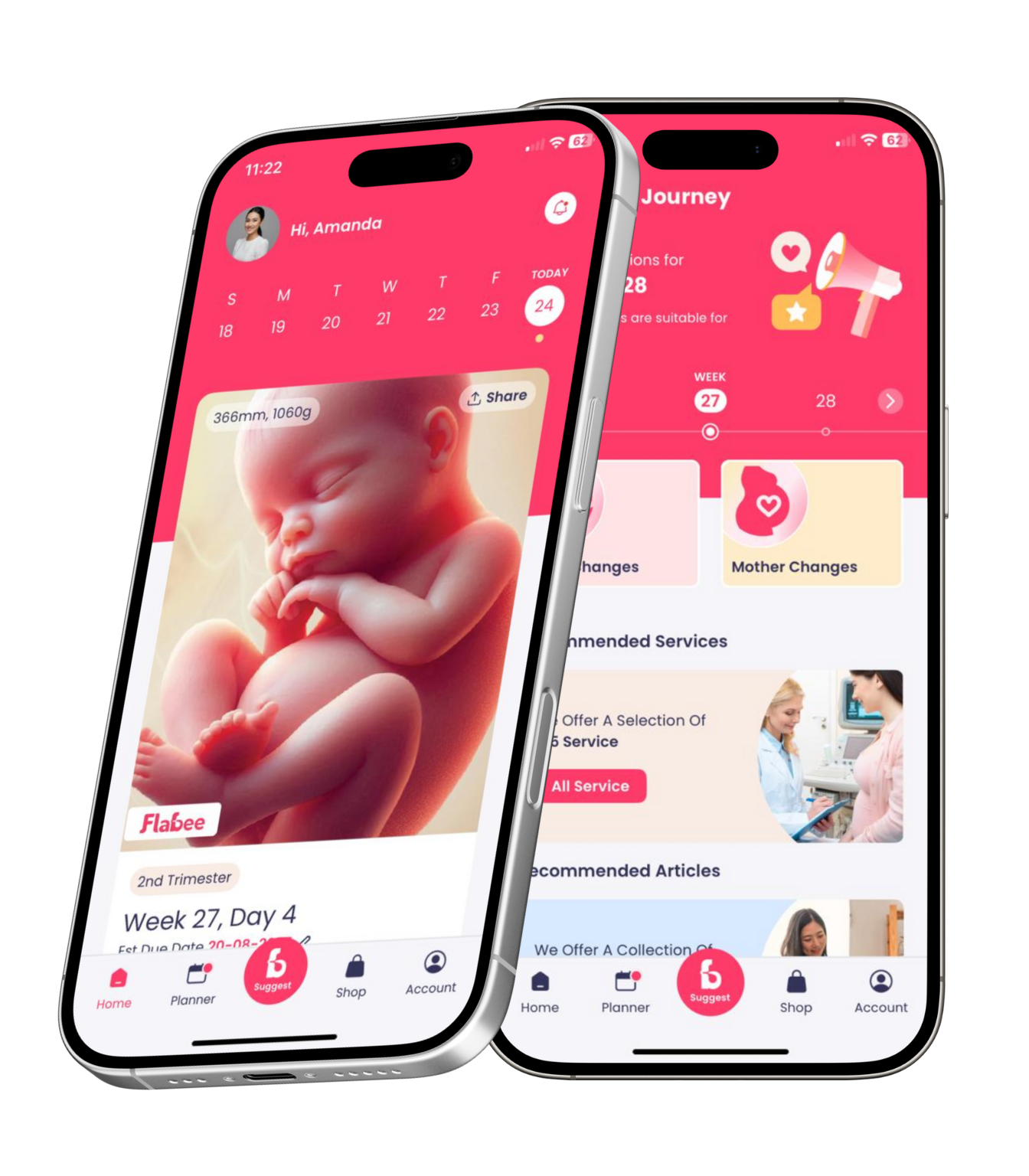
At Flabee Care, we believe the first 1000 days of a child’s life matter most, starting from conception. Our pregnancy tracking app is designed to empower you with tools like a built-in kick counter, weekly insights, and expert guidance. This article will answer the most common questions about fetal movement tracking, ease your worries, and show you why a few minutes of logging each day can make all the difference.
What is the Meaning of Recording Baby Kicks During the Third Trimester?
Recording baby kicks—often called fetal movement counting or “kick counts”—means systematically tracking your baby’s movements over a set period each day. It’s not about noting every single wiggle but identifying a regular pattern of activity.
Think of it as your baby’s daily “check-in.” Just like you monitor your blood pressure or weight gain, kick logging helps you understand what is normal for your unique baby. A consistent pattern of movement usually indicates that your baby is well-oxygenated and receiving adequate nutrients from the placenta. A sudden decrease or change in that pattern can be the earliest warning sign of fetal distress, allowing you to seek medical help in time.
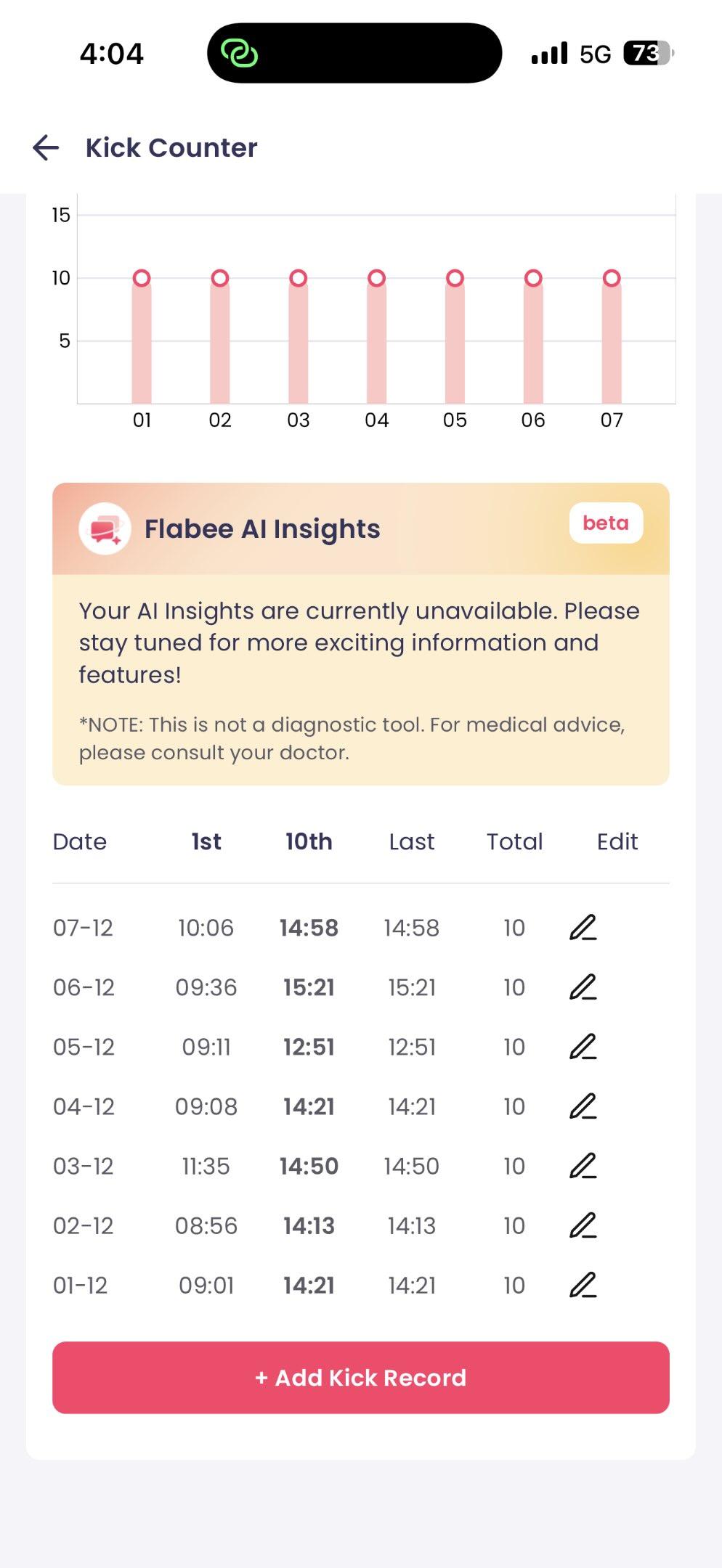
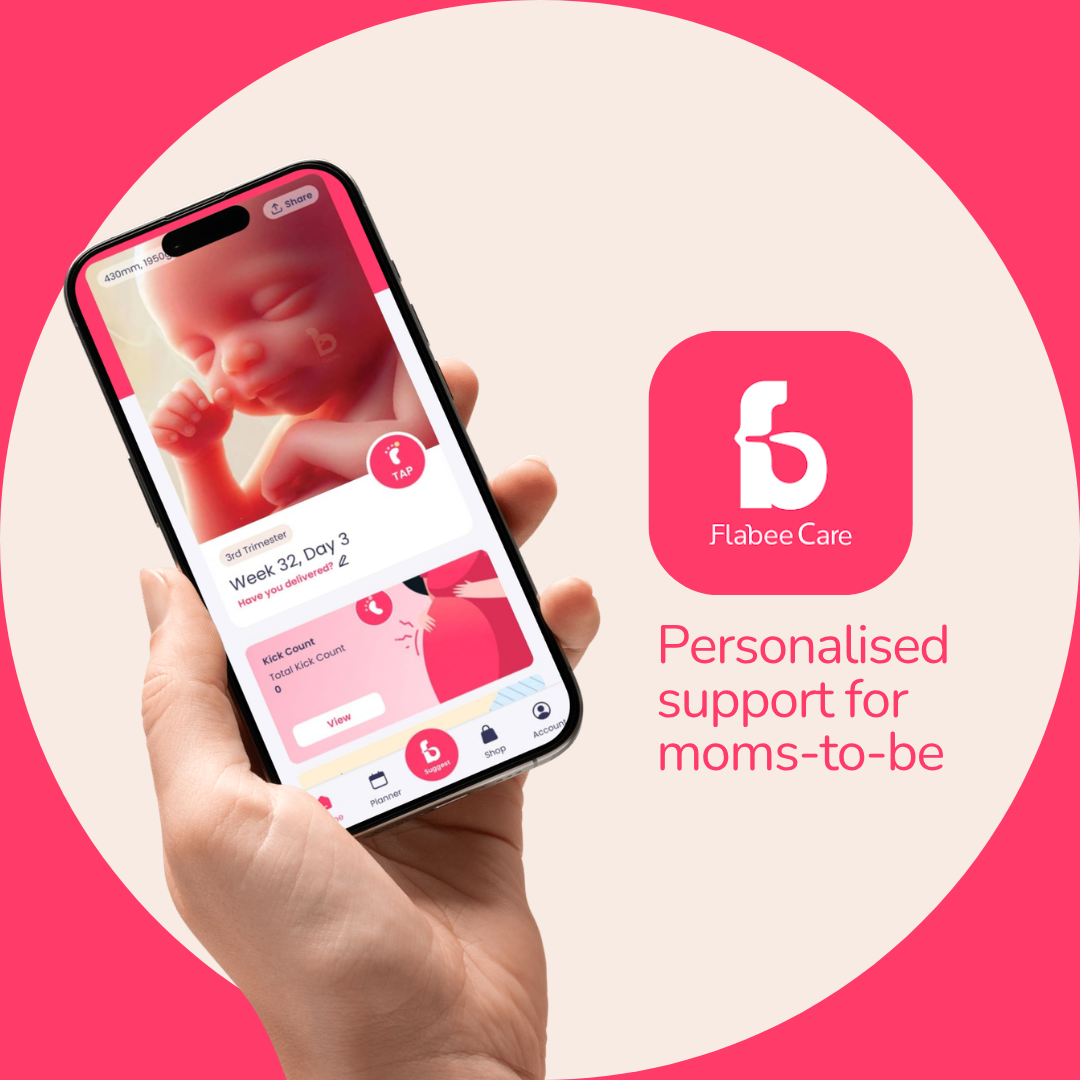
Recording is simple: you count movements (kicks, rolls, swishes, or jabs) until you reach a target number or note how long it takes to feel a certain number of movements. Tools like the Flabee Care app’s kick counter make this effortless, storing data so you can easily spot trends and share them with your doctor.
When Should I Start Counting Baby Kicks During Pregnancy?
Most healthcare providers recommend starting routine kick counts around week 28 of pregnancy. Why 28 weeks? By this time, your baby has developed a more predictable sleep-wake cycle (typically 20-40 minutes of sleep at a time). Before 28 weeks, movements may still be too irregular or faint to provide reliable data, especially for first-time moms.
However, you don’t need to wait until 28 weeks to pay attention. Begin noticing your baby’s general activity patterns as early as week 24. If you have a high-risk pregnancy (e.g., gestational diabetes, preeclampsia, or a history of stillbirth), your doctor may ask you to start formal kick counts earlier, around week 26.
Remember: “counting” doesn’t mean obsessing 24/7. It means choosing a consistent time each day—usually after a meal when blood sugar is higher and baby is more active—to sit quietly and log movements. Flabee Care’s weekly guidance can remind you when to begin tracking based on your exact due date.
How Many Baby Kicks Per Hour Are Normal in the Third Trimester?
This is the most common question, and the answer is reassuring: there is no single “magic number” for kicks per hour. Healthy babies vary widely. However, most obstetricians use the “count to 10” method.
Here’s how it works:
- In healthy third-trimester pregnancies, you should feel at least 10 movements within 2 hours (many babies achieve this in 15-30 minutes).
- Some active babies may deliver 10 kicks in under 10 minutes; others take 90 minutes. Both can be normal—consistency matters more than speed.
If you haven’t felt 10 movements in 2 hours, don’t panic. Try drinking cold water, lying on your left side, and focusing for another hour. If you still don’t reach 10, call your healthcare provider.
What about kicks per hour? A common myth is that “4-6 kicks per hour” is the standard, but babies sleep frequently. It’s perfectly normal to have an hour with only 1-2 kicks followed by a very active hour. That’s why the 2-hour window is preferred—it accounts for sleep cycles.
The Flabee Care kick counter automatically timestamps each movement, so you can see exactly how long it takes to reach 10 kicks without mental math.
What’s the Best Way to Log Baby Kicks — App, Paper, or Just Mentally?
Let’s compare the three methods honestly:
| Method | Pros | Cons |
| Mental tracking | No tools needed | Highly unreliable; anxiety makes memory worse |
| Paper log | Simple, tangible | Easy to lose; no alerts or trends; hard to share |
| Mobile app (like Flabee Care) | Automatic timers; charts patterns; sets reminders; easy to show doctor | Requires a smartphone |
The best way is an app. Why? Because anxiety during pregnancy is real. When you think “baby moved less today,” your brain may not accurately recall yesterday’s activity. An app records objective data. Flabee Care’s kick counter feature allows you to:
- Start/stop a session with one tap
- See a history of your kick patterns by day and week
- Receive reminders to count at the same time daily
- Share a report directly with your doctor
Paper is fine if you prefer analog, but never rely on memory alone. Studies show that mothers who use formal counting methods (app or paper) detect decreased fetal movement earlier than those who rely on feeling alone.
Should I Worry If My Baby’s Kick Pattern Changes but Still Gets 10 Kicks in 2 Hours?
This is a nuanced but important question. The short answer: not necessarily, but stay alert.
Babies, like adults, have “active” and “quiet” days. As you move from 28 to 40 weeks, your baby has less room to somersault, so kicks may feel more like stretches and rolls. A gradual, subtle change in the type of movement is normal.
However, a sudden change in pattern—even if you still get 10 kicks in 2 hours—deserves attention. For example:
- Your baby usually kicks strongly right after breakfast, but today feels sluggish for the first hour, then picks up.
- Movements feel weaker or different (e.g., fewer rolls, more shudders).
Trust your intuition. Many stillbirths are preceded by a mother’s vague sense that “something is different.” If the pattern change lasts more than a day, or if you feel a significant reduction in strength or frequency, call your doctor. They may want to do a non-stress test (NST) or biophysical profile (BPP) for reassurance.
Logging with Flabee Care helps you distinguish between a one-off quiet day and a true downward trend. The app’s history view shows your baby’s unique rhythm over weeks, so you’ll notice anomalies quickly.
Can You Feel Baby Kicks Less Often If You Have an Anterior Placenta?
Yes, absolutely. An anterior placenta means the placenta attaches to the front wall of your uterus, acting like a cushion between your belly and the baby. Women with this condition often feel kicks later (after 22-24 weeks) and less intensely throughout pregnancy.
Key facts:
- You may feel only 50-70% as many movements as someone with a posterior placenta.
- You might miss small rolls or finger movements entirely.
- But you should still feel some strong kicks, especially as baby grows.
The “count to 10 in 2 hours” rule still applies. However, if you have an anterior placenta, your doctor may adjust expectations: it might consistently take you 90 minutes to reach 10 kicks, while another woman takes 20 minutes. That’s fine—as long as your pattern is consistent for you.
Warning: Do not dismiss a true decrease in movement because you have an anterior placenta. If you normally feel 10 kicks in 90 minutes and today you feel only 3 kicks in 3 hours, call your provider immediately. Flabee Care allows you to add notes (e.g., “anterior placenta”) so you and your doctor can interpret the data correctly.
How Long Should I Wait to Call My Doctor If I Notice Fewer Baby Kicks?
Do not wait more than 2 hours. Here is a simple, safe protocol:
- Drink a cold glass of water or juice and lie on your left side (improves blood flow to the uterus).
- Focus on counting for up to 2 hours using an app or timer.
- If you feel fewer than 10 movements in 2 hours → call your doctor or labor & delivery triage immediately. Do not wait until morning or “see if it improves.”
- If you feel 10 or more but the movements are much weaker than usual or the pattern has changed for 24+ hours → call for advice.
Never feel embarrassed about calling. Obstetricians receive calls about decreased fetal movement daily. It’s always better to be checked. Many times, they’ll have you come in for a quick 20-minute NST. Usually, everything is fine. But if there is a problem (e.g., low amniotic fluid or placental insufficiency), early intervention can save your baby’s life.
The Flabee Care app can help you time exactly how long counting takes, removing the guesswork when you’re already anxious.
Does Drinking Something Cold or Eating Sugar Really Make the Baby Kick More?
Yes, for most babies—but not all. This is a well-known “trick” among pregnant women, and it has some scientific basis:
- Cold drinks may startle the baby or cause a slight rise in your metabolic rate, prompting movement.
- Sugar (juice, soda, candy) raises your blood glucose, which crosses the placenta and can give baby a temporary energy boost.

However, it’s not 100% reliable. Some babies are unresponsive to sugar. Others move less after eating because they’re content. The technique is useful as a one-time test if you’re worried: drink 8 oz of cold orange juice, lie down, and count for 2 hours. If baby responds, great. If not, still call your doctor.
Important warning: Do not use sugar/cold drinks to repeatedly “force” movement if your baby is consistently quiet. That masks a potential problem. The goal is to observe natural movement patterns, not to stimulate baby for every count.
Can Logging Baby Kicks Help Prevent Stillbirth, or Does It Just Increase Anxiety?
This is an honest, crucial question. Let’s look at the evidence.
The research is clear: Formal kick counting reduces stillbirth rates by approximately 30% in multiple large studies. Why? Because most stillbirths are preceded by decreased fetal movement in the prior 24-48 hours. When mothers log kicks daily, they detect this decrease earlier, seek help, and doctors can intervene (e.g., induce labor, treat placental issues).
But can it increase anxiety? Yes, for some mothers—especially those with pre-existing anxiety disorders or a history of loss. Mindset matters. Here’s how to log kicks without spiraling:
- Do it once a day at the baby’s most active time (not 24/7 monitoring).
- Use an app (like Flabee Care) that shows reassuring patterns over time, not just raw numbers.
- Remember: a single slow day is rarely an emergency. A trend of slowing is the real red flag.
- Talk to your doctor if counting makes you obsessive. They may adjust the frequency (e.g., every other day).
The majority of mothers feel more empowered, not more anxious, because logging gives them actionable information. Instead of wondering “is that enough movement?” you have data. And when you go to the doctor, you bring facts, not fears.
Flabee Care is designed to support your mental health too, with expert tips and a simple, non-alarming interface.
Final Thoughts: Empower Yourself with Flabee Care
Logging your baby’s kicks is one of the most powerful, low-tech interventions available to you. It costs nothing but a few minutes a day, yet it can detect problems before any other sign appears. The key is consistency, not perfection.
With Flabee Care, you’re never alone in this journey. Our app provides:
- A simple, one-tap kick counter that records every movement
- Weekly pregnancy insights so you know what to expect at each stage
- Appointment scheduling for ultrasounds and massages
- Fertility and period tracking for your future family planning



Download Flabee Care today from the Play Store, App Store, or Huawei AppGallery. Let’s make every kick count—for your peace of mind and your baby’s safety.
10 FAQ Related to Recording Baby Kicks During the Third Trimester
1. Can I lie on my back while counting kicks?
No. Always lie on your left side during kick counts. This optimizes blood flow to the placenta and makes movements easier to feel.
2. What if my baby moves less after I exercise?
Temporary mild reduction is normal due to redirected blood flow. Wait 30 minutes after resting, then do your kick count. If still low, call your doctor.
3. Do twins make kick counting different?
Yes. Count each baby separately (harder but possible). Many doctors recommend monitoring each twin’s distinct “territory” for movement. Use notes in Flabee Care to track both.
4. How can I wake my baby for a kick count?
Besides cold/sugar, try: a gentle push on your belly, shining a flashlight, or playing music. Never shake your belly hard.
5. Is it normal for kicks to hurt in the third trimester?
Yes. As bones strengthen and space tightens, kicks can be uncomfortable or briefly sharp. But severe, constant pain is not normal.
6. What’s the difference between a “kick” and a “roll”?
Count both! Any distinct movement (jab, swish, roll, flutter) counts. Only hiccups do not count—they are rhythmic and involuntary.
7. My baby moves more at night. Is that okay?
Very common. Babies don’t know day from night. Just choose the same time daily (e.g., 9 PM) for consistency.
8. Does caffeine affect kick counts?
Caffeine can increase fetal movement temporarily. Avoid counting right after coffee to get a true baseline.
9. Can stress or anger reduce baby kicks?
Yes. High cortisol can reduce movement. If you’re upset, calm down for 20 minutes before counting.
10. Will Flabee Care store my kick count history after birth?
Yes. The app retains your pregnancy data, which can be helpful for future pregnancies or medical records.
Disclaimer
This information is intended for health education and awareness purposes only. It is not intended to replace professional medical advice, diagnosis, or treatment. Please consult a qualified healthcare professional for personalized medical advice.